Cabinets of Wonder — Professor Emily Conrad
Experience Design Manifesto
My experience manifesto is oriented around movement. I want to exploit the fact that people's eyes, on a very basic level, are drawn towards moving things, be it a strange animal approaching you or a screen playing quick cut sports at the bar.
Capturing a person's attention is the first step towards their engagement. Being able to touch or otherwise interact with the moving object is step number two.
I want to create sites of wonder where people's eyes are arrested by movement and drawn in to question more. I want them to be able to engage with the movement or move an object, to activate that thing in them that yearns for discovery.
I am particularly interested in natural interpretive sites and science museums, so I will focus my manifesto on these topics.
As an example, text should be searched for, not shoved in ones face. I admire approaches like, a sea shell you can move to discover a picture and description of an animal that once lived in it. Pelts which can be pushed aside to encounter a description of the animal they once adorned. I want difficult information to be hidden behind accessible touchable stuff. I think text should be discovered, not presented.
I want to present intuitive engagement which spirals into deeper learning. Make things exciting to touch and hold and play with and then comes increased access to the knowledge the piece conveys.
Touch -> Play -> Learn
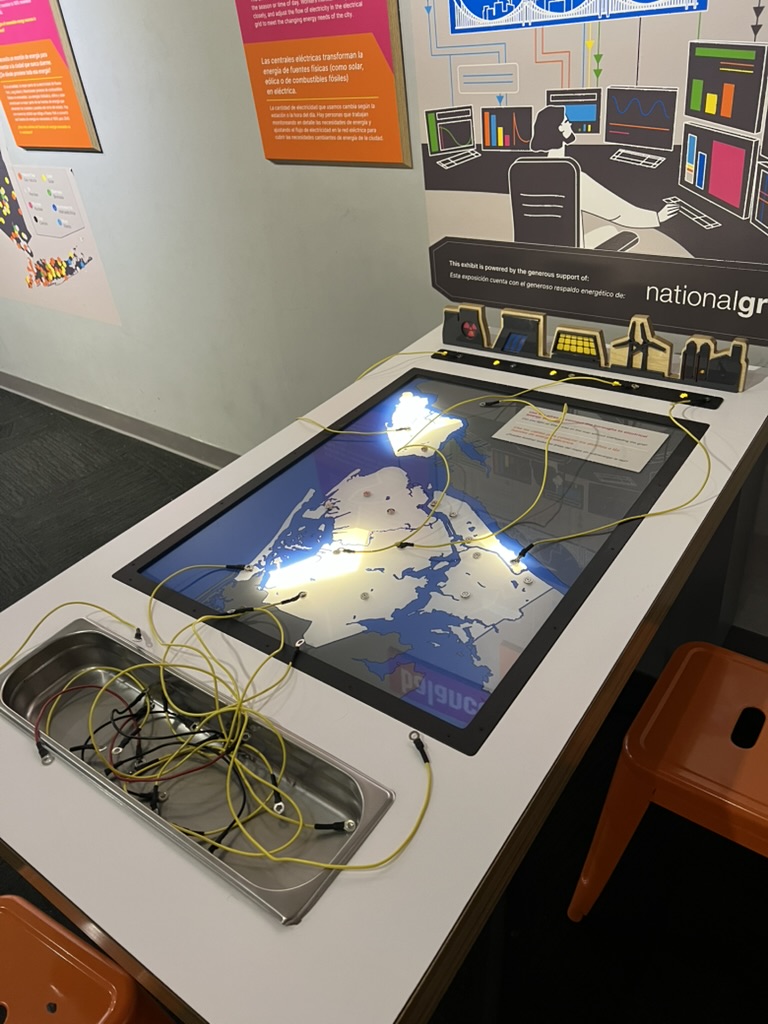
A piece which does this well exists in the NYSCI, although much of this experience is text heavy, this piece is relatively bare. I wish the interaction was more inviting, something which could be created though increased contrast for the locations of interaction, the magnetic links. Although this piece is static, the movement of its users gets close enough.
Another piece which I liked was the vocal recounting of a person's lived experience in new York's china town in the 1970's. The button to play the recording was static, but it could have subtly pulsed to draw the patron in even more.
Movement should not be overdone, but it is the centerpiece of any particular experience. Care should be taken to avoid visual crowding and use movement especially to focus attention to a particular place. Passive sources of more interaction driven movement balance out the space.
Crucially, it needs to be physical touchable things that move in order to really capture the wonder of the audience. Screens fail, intangible interaction fails, physical objects in the hand, while they may break, do not fail to communicate.
If I were to present an artifact, I would have a 3d printed replica available for patrons to hold.
If I were to present a poem, I would make people read it with a looking glass.
If I were to present a history, I would have an automaton reenact a scene.
If I were to present a natural phenomena, I would bring it into the room with the viewer.