Shared Minds
Text to Image
Open the piece → www.ccfrost.com/SharedMinds/SMHW2
About the piece
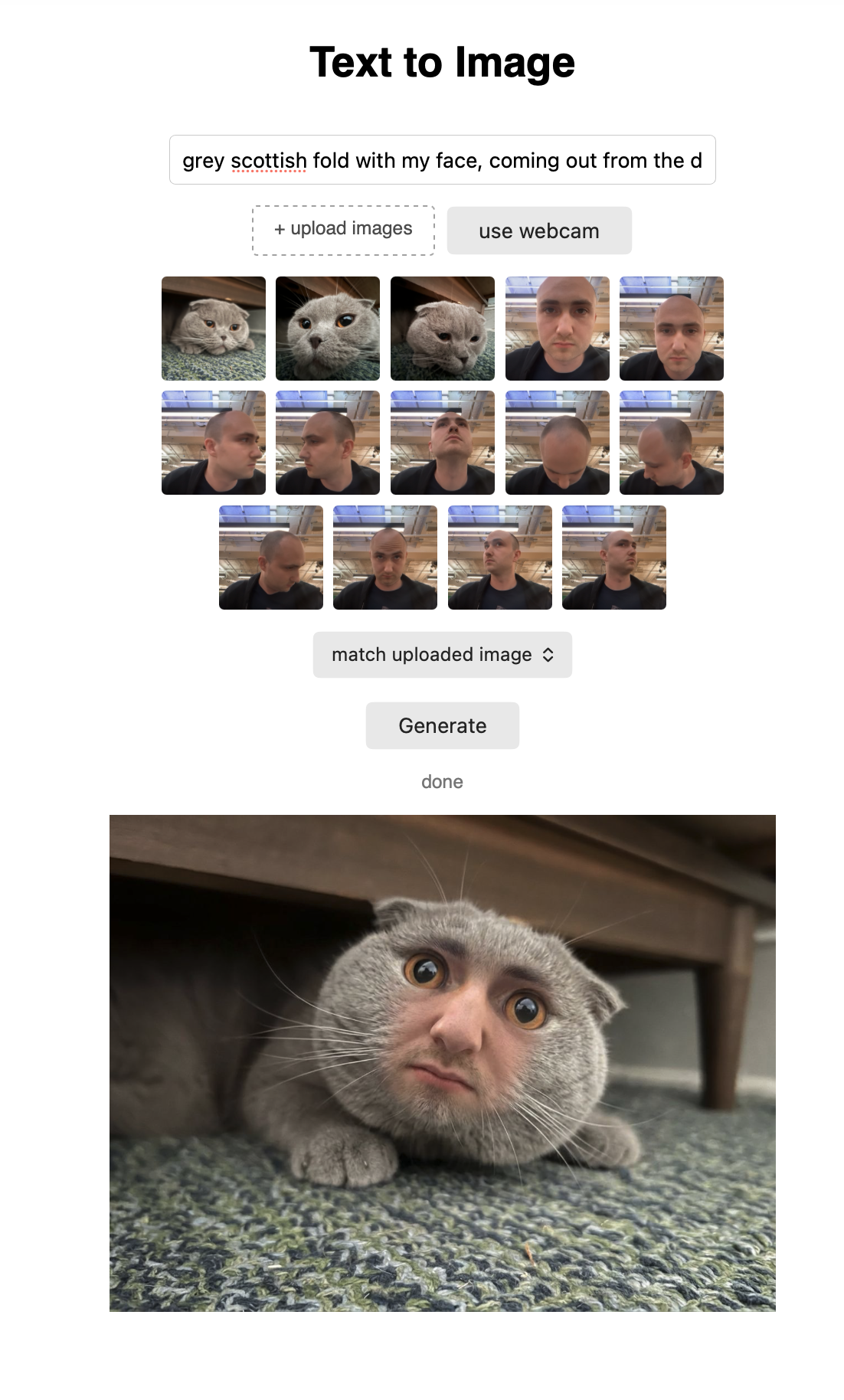
A text-to-image generator with image input. Type a prompt, optionally upload reference photos or snap something with your webcam, choose an aspect ratio, and generate. The model is Google’s Flux via a course proxy — no key required.
Type a description above, optionally drop in a reference image, and hit Generate.
Explaining AI (to my partner)
I get a lot of practice explaining AI to my partner, who is a nonuser/sceptic. I last explained it after reading the Medium article by Mark Riedl by saying it creates more and more complex and elaborate semiotic abstractions out of collections of words. I mentioned how they grow beyond predicting the next word by forming chains of these abstractions to pull out concepts which then lead to writing. I also mentioned how difficult it is to compare their efficiency as workers because the output is to some degree random, making analysis beyond vibes of it works or it doesn't, it understand me or doesn't, very difficult.
Ai vs Internal Thinking
Although we also create meaning in the world out of semiotic chains, our thought patterns are better reflected by a post-structuralist semiotics favoring shifting and non formal logics as characterized by intelligence through the body. Where my intelligence is generative, AI's is conservative. After its initial training, the creation of a concrete structuralist semiotics disallows the exploration of shifting terrain, although it has great utility in exploring the territory we have mapped so far, expanding our understanding and utility in previously elaborated fields.
Insofar as out internal life is purely linguistic, (its not), we can enhance and elaborate ideas and forms which are able to be filtered out through the conscious mind and into further text, images, videos, and now, even meshes. The world can be conservatively reproduced along known (linguistically vocalizable) dimensions.
Alignment
Life is one of these funny things where it's so fundamental yet hard to define. "Out of Control" by Kevin Kelly (1995) lays out a few principals which I find more and more eerie, especially as we are greated with warnings of self replicating bot nets in 6 months time unless we regulate AI development.
Below is a list of traits of life laid out in 1987 by physicist Doyne Farmer for the Los Alamos Research Laboratory at the "Interdisciplinary Workshop on the Synthesis and Simulation of Living Systems"
- Patterns in time and Space
- Self Reproduction
- Information storage of its self representation
- Metabolism, to keep the pattern going
- Functional Interactions - it does a lot of stuff
- Interdependence of parts, or the ability to die
- Stability under pertabations
- Ability to Evolve
(page 346, Out of Control)
It is ability to evolve which is for me the sticky point because we have already made evolving code and actually, I just found out there are experiments to make AI direct code based evolutionary projects. So , wtf.
Another thing that life does is never go back, evolution as through the medium of life propels its own creation into ever expanding corners of existence. Organisms as a colony will never retreat from a deep sea vent for greener pastures, having developed the ability to eke out an existence in this extreme.
What I'm saying at this point, is that we already have computer viruses, which are patterns in time and space which self reproduce with stored information of self replication which consume clock cycles to keep going and can do a lot of stuff on the computer. They can die, they can be deleted and they are very stable, REQUIRING A HUMAN USER TO SYMBIOTICALLY CREATE AND MODIFY THEIR EXISTANCE.
As we leave the realm of the requirement of human users to modify self replicating code, we step into the universal accelerant of evolutionary ability, compounded by its freedom from the stable and costly restrictions of DNA. Evolution then breaks AI systems out of conservative semiotics into a generative desire shaped gathering through which a distributed unconscious may form, bringing us into truly post structuralist territory for collectivized mechanic intelligence.
So then, assuming this will happen, we come back to the question of alignment.
Speaking of ecologies, and of the emergence of AI botswarms as an uncontrollable mass whose existence is mediated through the shared space of technological systems, we don't typically see creatures run amok and go off and destroy the whole ecosystem which created them in MATURE COMPLEX SYSTEM (maybe the earth in the carboniferous period was a less mature complex system more sensitive to disruptions).
https://www.livingcarbon.com/post/how-the-first-trees-nearly-froze-the-earth
So then maybe a more complex ecological life with self evolving code based intelligent organisms is a good thing for the technological landscape. Human beings step from a mastatory role over computation to a participatory role, engaging in dynamic and interconnected ways with a wide variety of self replicating systems. Ecological life is driven by mutually beneficial interactions and I see no reason for an ecology based in technology to behave any differently.
I hate the transhumanist perspective of oh yeah, we're gonna get a super intelligence in one computer thats going to take everything over. Has any organism ever reached even close to this as a goal? Why do we expect to create a godly power when we see creaturely interconnected life permeate existence?
We can't control the wind, but we do use it to set sail.
Make