Exploring Concepts from Soft Robotics — Professor Kari Love
Soft Robotic Research Paper
For our reading exercise I picked a paper on Rapid Liquid Printing of silicone actuators. All of the technical content, screenshots, and figures discussed below come from the paper itself — full citation:
Sparrman, B., du Pasquier, C., Thomsen, C., Darbari, S., Rustom, R., Laucks, J., Shea, K., & Tibbits, S. (2021). Printed silicone pneumatic actuators for soft robotics. Additive Manufacturing, 40, 101860.
DOI: 10.1016/j.addma.2021.101860
This paper investigates 3D printing 2-part silicone into a water-based gel mixture typical for bio fabrication. I am obsessed with tactility and clarity, so this paper speaks to me. I have also been interested in non-moldable geometry. The paper also mentions printing using MMPP, a method I am familiar with but dislike greatly.
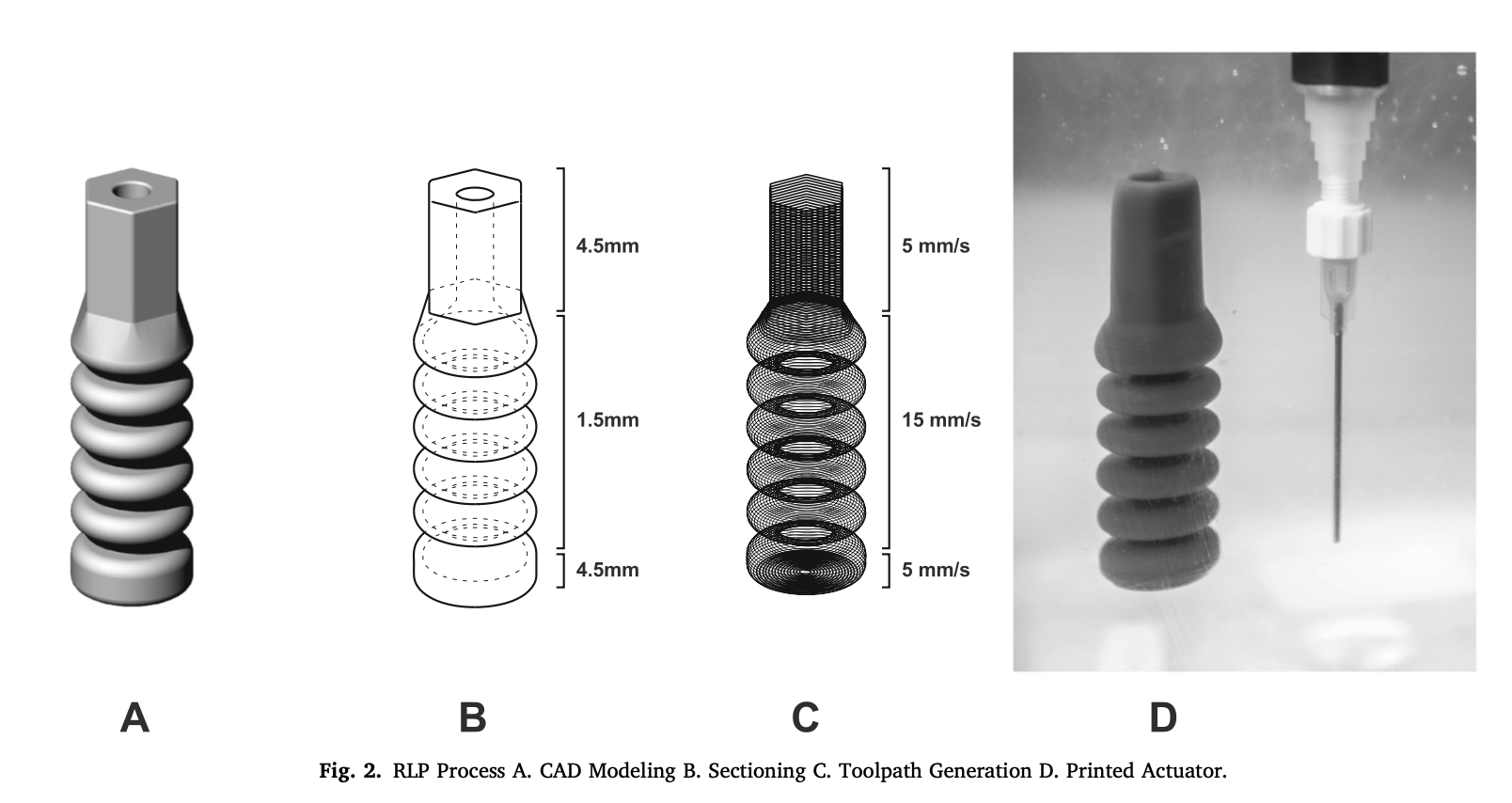
Figure from Sparrman et al., 2021, Additive Manufacturing 40: 101860. doi.org/10.1016/j.addma.2021.101860
RLP Printing
The paper benchmarks soft robotic muscles by their elongation, force exerted, cycling fatigue, and maximum pressure withstanding. Of these, I am most interested in cycling fatigue. I am also reading this paper as a guide towards doing RLP printing. I will summarize the information as such.
Printable silicones can be done with pleats or bellows to increase their deformation range. Also, very soft silicones can achieve up to 1000% deformation, although I doubt this stability.
Ecoflex and Dragon Skin are commonly used silicones.
The uncured silicone is mixed through a static 1-to-1 mixer through an 18 gauge nozzle into a water-based gel. The paper references possibilities to use a robotic arm gantry or a CNC machine; this paper used the ShopBot.
The CNC path is broken down into a helical toolpath with a .5mm horizontal stepover. The toolpath stepover and the extrusion rate are controlled with the only variation in wall thickness occurring by the speed at which the nozzle moves. As you can see in the graphic below, the samples are essentially printed in spiral vase mode with a single continuous path composing the entirety of the body. From here, the wall thickness is calculated off the STL and used to determine the speed at which to compose the shape. So then, the stepover ratio is the rise vs the run, with the reported ideal coming between 1:2 and 1:4.
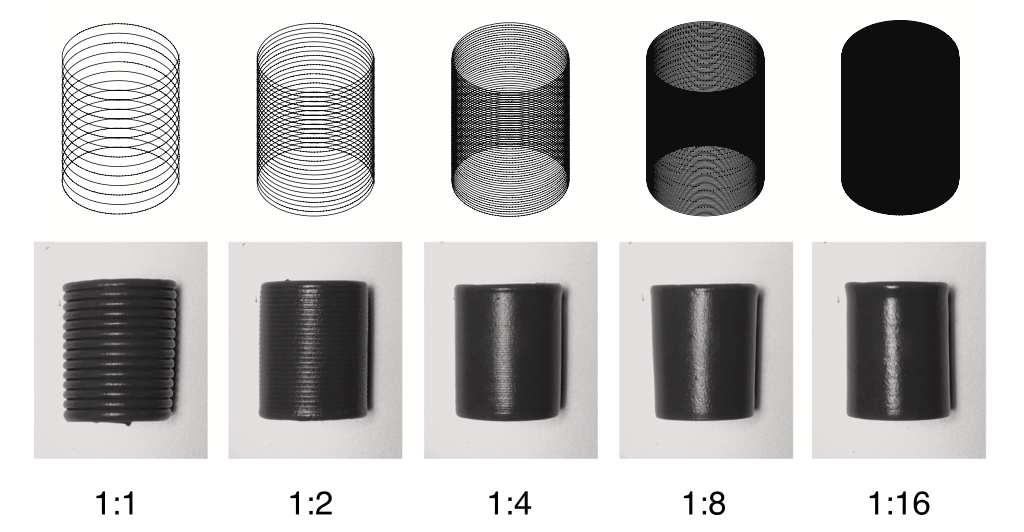
Figure from Sparrman et al., 2021, Additive Manufacturing 40: 101860. doi.org/10.1016/j.addma.2021.101860
For a theoretical application, it is noted that several different parts can be done at different nozzle orientations and a script applied to sort them to avoid collisions.
For post processing, the parts are left to cure for at least 2 hours and then removed from the bath. From here, they are washed with water and left to dry. In this test, the actuators are post-cured for 2 more hours at 80 degrees.
Casting
On the casting side of their operation I am interested in the methods described as well. Apparently we are dealing with a lost-wax casting operation where the mold interior is printed from PVA and the outside from ABS. This is an interesting strategy for home casting if you can print out anything from PVA without it frying.
Test Results
Of the test results, to me the most interesting is the failure rate, where 4/5 cast pneumatic actuators failed and 0/5 RLP actuators did. Further, cast actuators showed deformation after 200 cycles where the RLP actuators remained intact beyond 500 cycles. They also said that cast actuator standard deviation is 1.3 to 4.7 times higher than the RLP actuators. Overall, RLP is much more reliable than the other methods.
All quantitative claims, figures, and methodology described above are drawn from Sparrman, B., du Pasquier, C., Thomsen, C., Darbari, S., Rustom, R., Laucks, J., Shea, K., & Tibbits, S. (2021). Printed silicone pneumatic actuators for soft robotics. Additive Manufacturing, 40, 101860. https://doi.org/10.1016/j.addma.2021.101860. Any inaccuracies in summary or paraphrase are my own.