Thesis — Professor Kari Love
Research by making, cycle 2
Voice Notes
Today I was able to rig up the test environment for my circuitry with three balloons and a chicken wire cage. This was successful.
Chicken wire was difficult to work with because it was hard to stretch over the very thin cross members that I used. The cross members were a very flimsy wood and the chicken wire contorted them severely, which made the cube not as beautiful as I would like it to be, but other than that it came together okay.
It took me from about 6:00 p.m. to 9:00 p.m. to do the Cube with the Brad Nailer and glue I don't think that glue did anything, but it came together.
So then I used zip ties on it as well. The zip ties were very nice to stretch it out. I also found that using, Velcro was very effective.
So the vibe coding on my circuit went well. I got Teflon tape, which made the off-gassing from the air pressure generator a lot less severe, which increased my run time. It is necessary to go to an air pressure generator with a lower decibel, something more for human compatibility, like for airbrushing.
We had a balloon pop at 1.5 psi. I integrated a check to add the safety per the previous K. Love's suggestion of figuring out the casualty point and then working back 20%.
It's very interesting to see the model (claude) running the sculpture. I like that aspect of it. There's something fun about having something else control the sculpture in another way. Like having an LLM control sculpture is very interesting because of the randomness that it produces.
Shapes like the star are the most exciting to observe because they have the most dynamic throw. So the star versus the balloon is like an interesting struggle because the star pushes hard against the balloon. Of the horse or the butterfly. One is more spiky-fill and one is more cloudish and round. The balloons are strong enough to press into the chicken wire,
The main thing that I would like now is another set of valves to... That will allow me to put vacuum in or not. So the expansion for this is going to be to put vacuums in. I like having a tank, so having a tank is really important. It might require that I build my own tank, but that would be okay, because I can source those parts.
For now, I will continue testing with the motors and stuff that ITP has, and move to more sophisticated stuff when I have a better idea of my needs. We will put that on the list, though, for things that need to happen eventually.
The best movement was from the star. Let's check it out. We can make that get better.
Circuit
I created this circuit to control my air flow, right now, this can do just input, and theoretically, a vacuum channel. The current way they work is I can toggle them on to push air through the channel, and then release the toggle to let air escape.
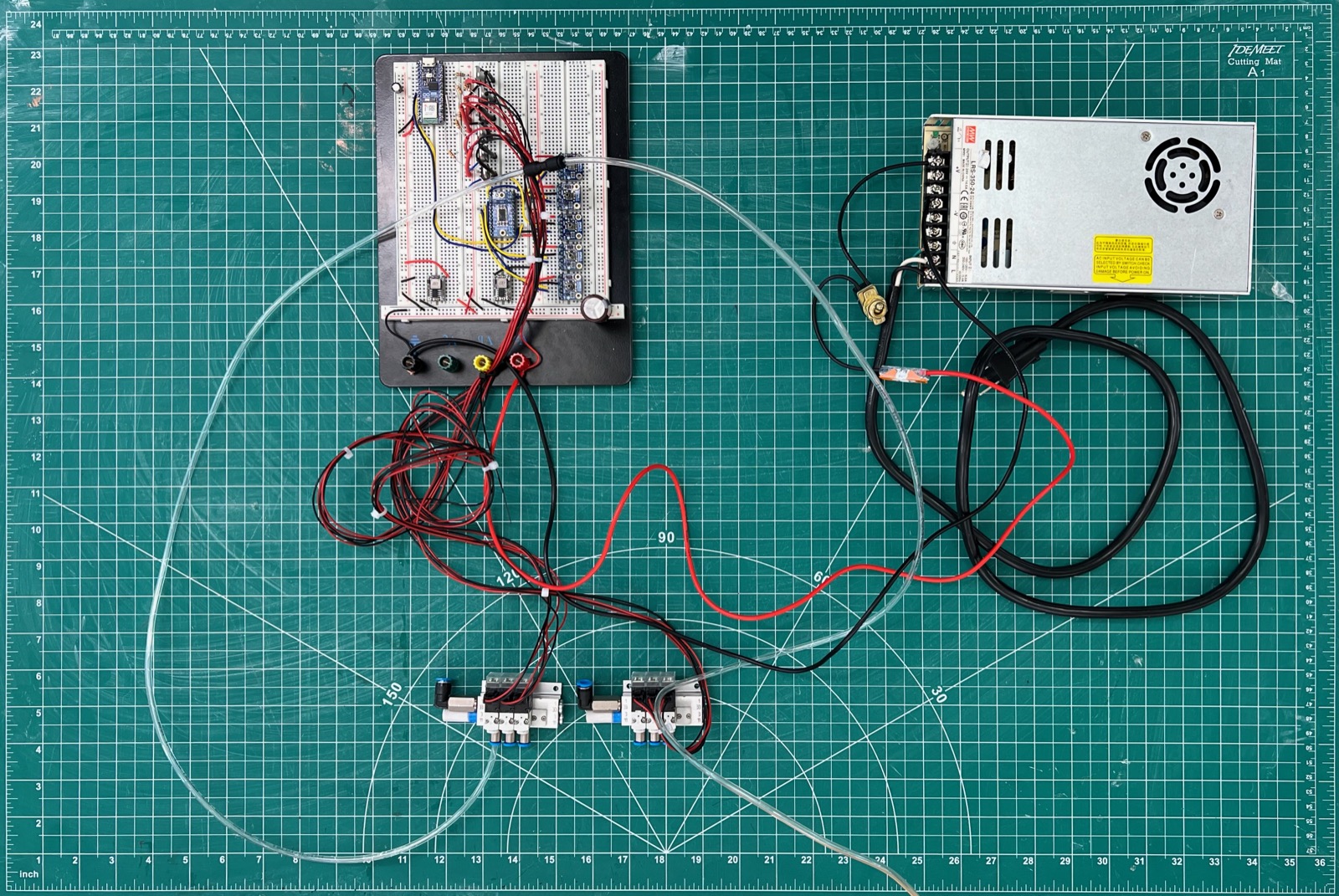
This setup is really poor for the work that I am doing because its very high psi low flow rate. For these mylar balloons which pop at like 2psi, I should be using blowers which max out at 2 psi. this would make these mylar forms a lot more dynamic. It would be worth pursuing this train of thought.
Post Process 4 Update
I need to really start developing now the RLP technology and making sense of working within the size and specifications range for the machine I have. This experiment has taught me the importance of the size vs the form of this work. so like, if the size of sculpture is too large, the balloons will not be able to fill it fully. I am also now interested in experimenting more with this cage and developing a setup with multiple balloons, instead of just three.
Questions
What shapes should I try?
How many balloons?
Does this feel like an authentic exploration of my research interests?
Is it worth trading off more control for more size? If I continue with printing my balloons, I will not be able to work in this scale. Is the scale going to be important for the impact?
Potential Tasks
- wire up a latex balloon mass inflation setup
- research creating a pcb board circuit for this device
- develop a vacuum system
- try blower motors
- cut down box size, or remake box with stiffer members