Understanding Networks — Professor Tom Igoe
ICANN Report
History
One text file: HOSTS.TXT
- 1972: Elizabeth "Jake" Feinler joins the ARPANET team at Stanford Research Institute (SRI), later leads the Network Information Center (NIC).
- 1972–1989 (~17 years): her team keeps the directory matching each computer's name to its address, published as one plain text file,
HOSTS.TXT. - Example entry, 1982:
HOST : 10.0.0.73 : SRI-NIC :(10.0.0.73 is the IP address; SRI-NIC is the name, and also the machine you downloaded the file from). - Every computer downloaded the whole file. NIC updated the main copy, but as more computers joined, everyone's copy went out of date.
Jon Postel's list of numbers
- 1972: Postel proposes one shared list so computers agree which number means which service. Early version of port numbers.
- Today: 21 file transfer, 22 SSH, 53 DNS, 80 web, 443 secure web.
1983: DNS splits up the directory
- Paul Mockapetris designs DNS so each organization looks after its own part of the directory. Ask only for the address you need instead of downloading everything.
- DNS runs on port 53, which ties back to Postel's list.
- Lookup from scratch: your computer → root server ("ask the .com servers") → .com servers ("ask example.com's server") → example.com's server ("here's the IP").
- The root is the one set of directions everyone has to agree on. That's the thing ICANN ends up looking after.
IANA, ICANN and PTI
- IANA is a set of jobs, first done by Postel's team at USC: who handles each domain ending, large blocks of IP addresses, shared numbers like ports.
- The U.S. government funded the early network and supported Postel's work.
- 1998: as the internet goes global, the U.S. backs creating ICANN, a nonprofit with people from around the world, to take on the IANA jobs. The U.S. keeps oversight through a contract, meant to be temporary.
- 2016: the internet community has a plan for oversight, the U.S. lets the contract expire. The work keeps going.
- Today: PTI (Public Technical Identifiers) does the IANA work for ICANN.
If DNS is a phone book
- ICANN is the publisher; it looks after the index page.
- The index page is the root.
- IANA is the job, "index page writer"; PTI is the one doing the writing.
- DNSSEC (DNS Security Extensions) authenticates the entries.
- The Root Zone Key Signing Key (KSK) is the ink.
The root key
- The KSK is stored in an HSM (hardware security module).
- Physical keys (some metal, some smart cards) open the locks.
- Two groups of crypto officers (7 each, one group per site: El Segundo, California and Culpeper, Virginia), plus a third group of 7 recovery key shareholders.
Leadership and Goals
CEO
Kurt Erik "Kurtis" Lindqvist is the ICANN President and Chief Executive Officer (CEO), communicates organizations milestones, activities and progress towards established goals and objectives.
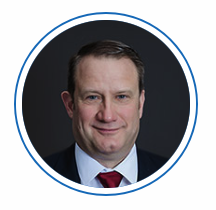
Previously served as the CEO of the London Internet Exchange (LINX) (a meet me room) previously served on the Internet Architecture Board IAB and lead working groups within the Internet Engineering Task Force IETF. and RIPE
works with the board to set goals, and reports back with about how the goals are going.
What are the current goals of the organization?
- strengthening ICANN engagement;
- So find new members for the sub organizations, or get better engagement
- increase engagement across stakeholder groups
- esp ones that lack training or direction
- through additional training and deployment of capacity
- promoting the multistakeholder model;
- (of the internet)
- take part in important global procicies
- increase effectiveness of community development policy advice including implementation and enforcement
- facilitating broader access to the Domain Name System (DNS);
- by reviewing current generic top level domain program 2026 round application window
- supporting the policy development process;
- improving operational excellence.
Who controls ICANN (it's a network)
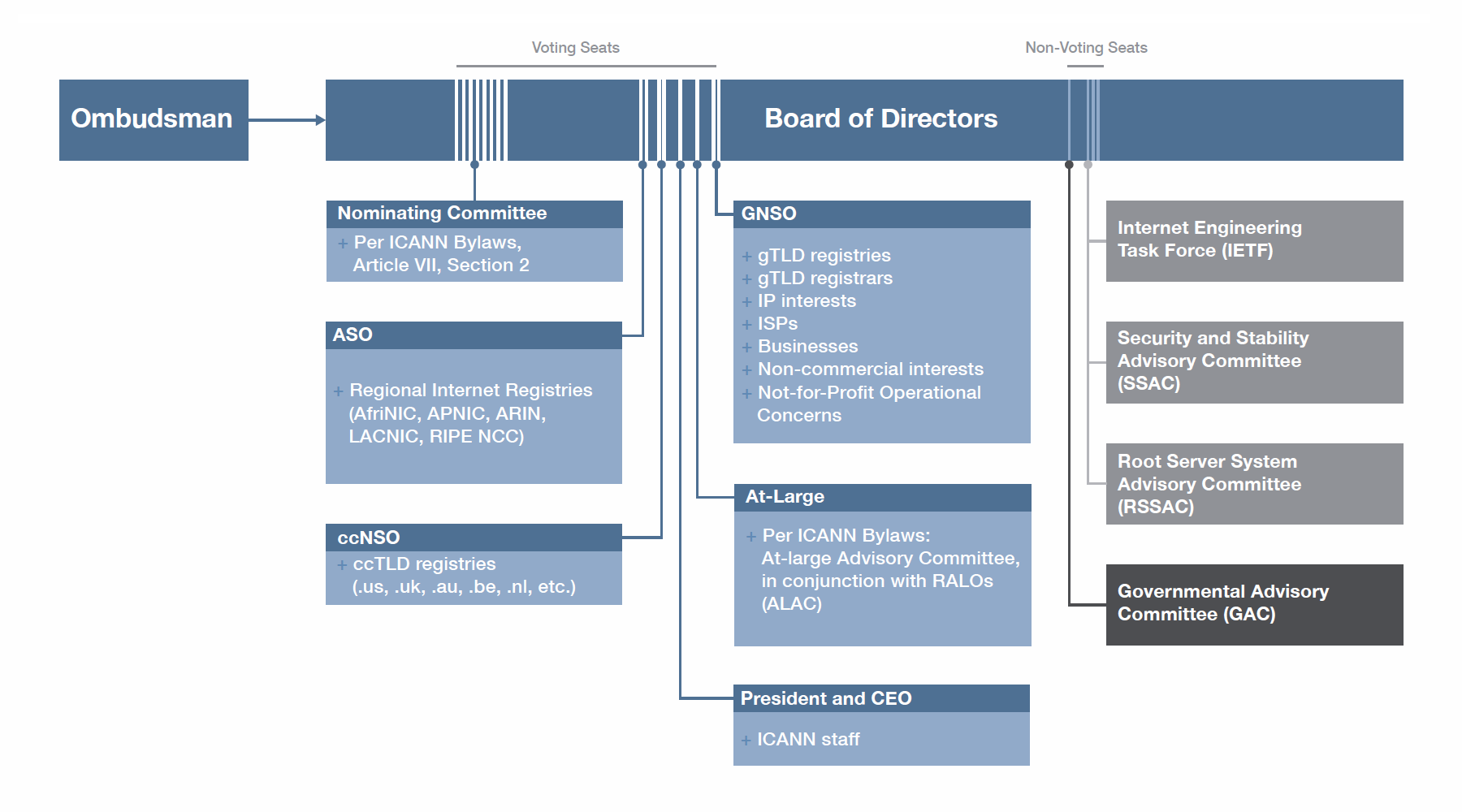
- Three parts (ICANN for Beginners infographic): the Community (volunteer stakeholders who give advice and develop policy), the Board (picked by the community, gives strategic oversight), and ICANN org (staff and resources). Our working-session analogy: community = voters, board = Congress, org = president.
- Board: 16 voting members plus 4 non-voting liaisons.
- Nominating Committee: 15 voting delegates from across ICANN, to keep it balanced. They pick 8 of the 16 board seats.
- Supporting organizations (write policy, also seat board members):
- GNSO, Generic Names Supporting Organization (.com, .org and the other generic endings).
- ccNSO, Country Code Names Supporting Organization (.uk, .cc and other country endings)
- ASO, Address Supporting Organization (IP addresses, through the regional internet registries)
- Non-voting liaisons pass along expertise from other groups. From the org chart: IETF, the Security and Stability Advisory Committee, the Root Server System Advisory Committee and the Government Advisory Committee.
- Advisory committees: GAC (Government Advisory Committee, government reps) and the At-Large Advisory Committee (individual internet users).
- Empowered Community: GNSO, ccNSO, ASO and the advisory committees.
- ICANN org reports to Kurtis; runs contracts and puts on meetings.
- "The Peoples Champion": Justine Chew, board member selected by the At-Large Community.
- "THE BIG DOG": Kurtis Lindqvist, board member, on the Executive Committee of the Board.
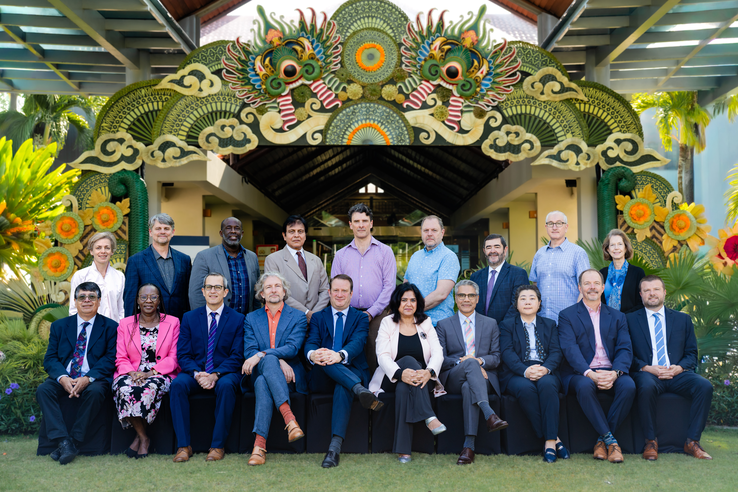
The Board has 16 voting members and four nonvoting liaison representatives.
Drama
Who gets a name, and who decides?
.amazon: countries or the company?
- 2012: ICANN opens the new gTLD program, anyone can apply for an ending for $185,000. Amazon applies for .amazon (among others). Brazil and Peru lead the opposition.
- The U.S. pushed for it in the GAC, then abstained. 2014: GAC reaches consensus against it, .amazon is blocked.
- 2017: Amazon asks for an Independent Review (IRP). The panel agrees with Amazon: no solid public-policy reason to block it.
- Amazon reportedly offered the Amazon-basin countries Kindles and AWS credits; then a joint committee; then special domains for each country. The countries said no to all of it and wanted a role in governing .amazon themselves.
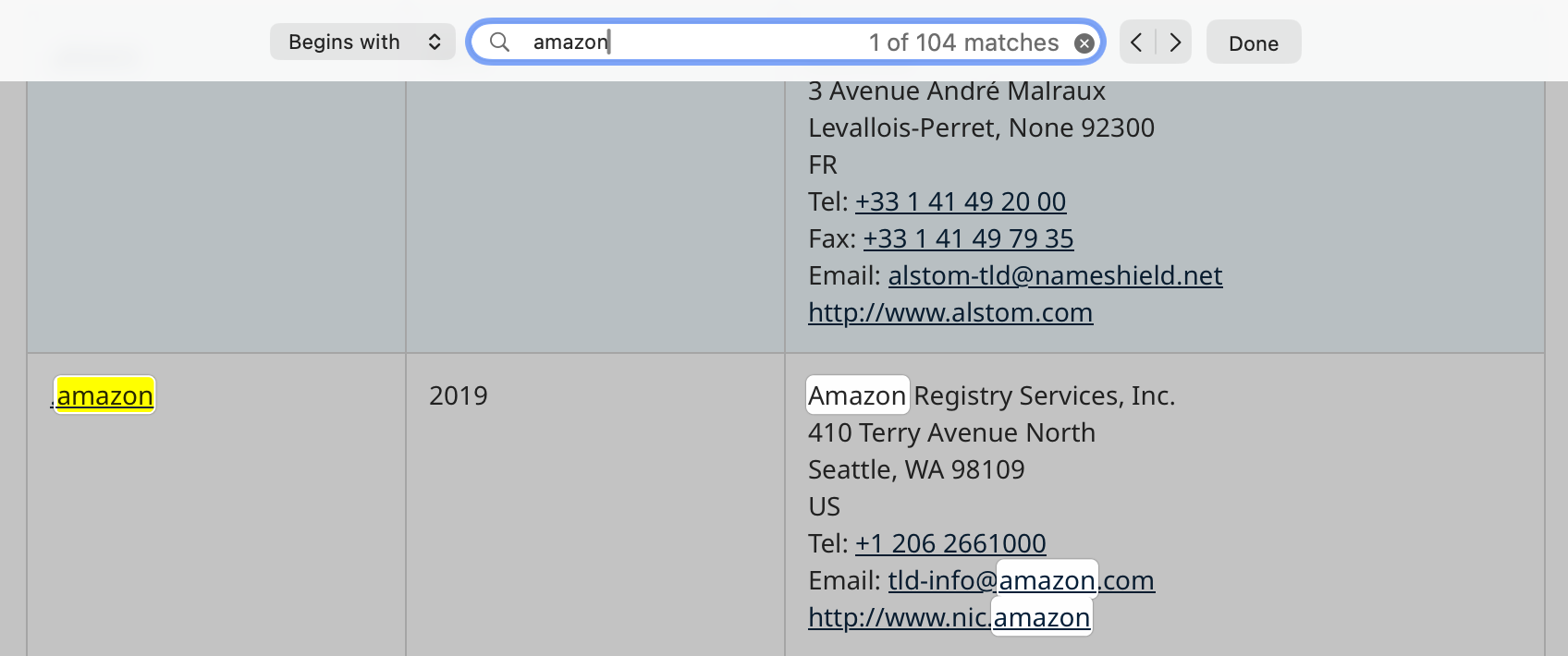
- 2019: with talks stalled, the board gives Amazon .amazon.
.book
- Meant to be open to anyone, but only 2 are registered; waiting on Amazon to open it up.
.islam
- Asia Green IT Systems (Turkey) applied. The Organisation of Islamic Cooperation objected. The GAC couldn't reach consensus, ICANN froze the application, an IRP said ICANN couldn't just freeze it, and the board voted it down.
.africa
- South Africa's ZACR (ZA Central Registry) won it over DotConnectAfrica, Ethiopian tech figure Sophia Bekele's bid.
- Bekele won an IRP: the GAC had acted unfairly without enough consideration. (July 2015)
- A U.S. federal court in California then froze the delegation (April 2016). A Los Angeles court lifted the freeze on 3 February 2017, and .africa went to ZACR on 15 February 2017.
- ZACR also runs .capetown, .durban and .joburg.
WHOIS: ICANN vs the EU
- WHOIS lists who owns a domain. The GDPR, the EU's privacy law, is against publishing that.
- 2018: ICANN sued EPAG (a German registrar) to make it keep collecting the data; German courts said no.
- WHOIS is "sort of dying now". Ask Tom.
Not in the presentation
From other notes
- .org sale: ISOC set up PIR (Public Interest Registry) to run .org, and every .org registration pays PIR a fee. In 2019 ISOC tried to sell PIR to a private equity firm for ~$1.135B, and ICANN blocked it. Tom's read in class: ISOC is a nonprofit short on money and may have thought .org was mature enough to stand alone, but ICANN disagreed.
- IANA's parent org is ICANN, the same way ISOC is the parent of the IETF and IRTF: the parent sets broad principles and assigns specialist jobs to subgroups.
- RIRs: IANA hands large address blocks to the five regional internet registries, which sub-allocate them within their regions.
- Autonomous system numbers for networks also trace back to ICANN.
- The assignment asks: What is the mission, how does it fit into the internet today, who is in it, and what other orgs are they in?
From the Nov 8 working session
- Logo/tagline: "One World, One Internet".
- ICANN for Beginners: formed 1998, nonprofit public-benefit corporation, keeps the internet's unique identifiers "stable, secure, and unified".
- Current work: building a multilingual internet, courses (ICANN Learn), and the DNS Abuse Mitigation Program (botnets, malware, pharming, phishing, spam). Worth digging into how they address it: https://www.icann.org/dnsabuse
- Still to look up: the Ombudsman.
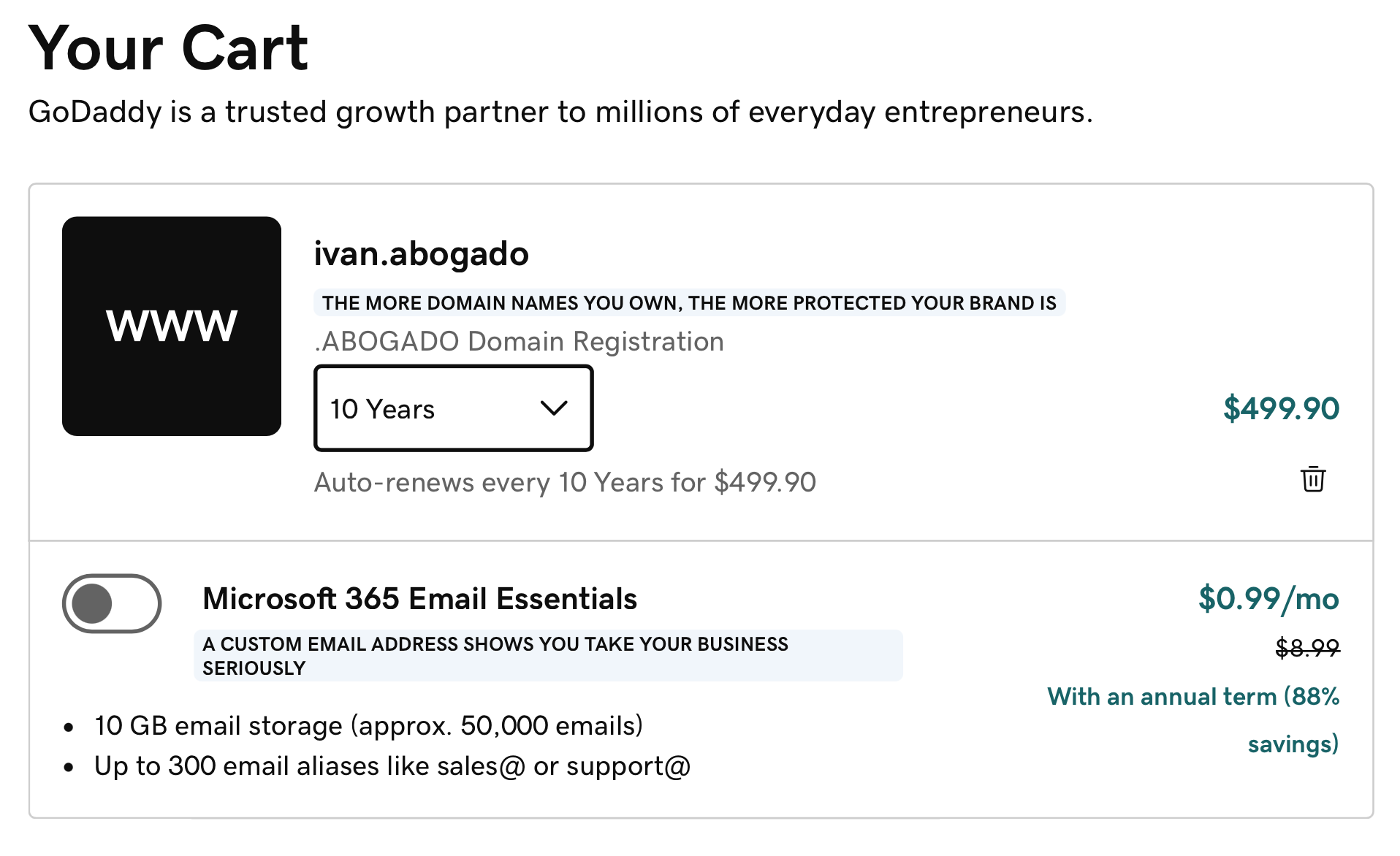
https://www.icann.org/en/contracted-parties/registry-operators/resources/listings

Sources
- Class deck: https://docs.google.com/presentation/d/1i6_fIyL2Gbq30Q5eYoaPFceHWrEKh3ikvt3JBv3KKvg/edit
- https://www.icann.org/en/beginners
- What does ICANN do (infographic): https://itp.cdn.icann.org/en/files/newcomer/what-does-icann-do-04-04-2020-en.pdf
- https://www.icann.org/dnsabuse
- Registry listings: https://www.icann.org/en/contracted-parties/registry-operators/resources/listings
- Root key officers: https://www.iana.org/dnssec/tcrs
- .africa: https://www.iana.org/domains/root/db/africa.html
- .amazon: https://www.theregister.com/2019/05/21/bezos_finally_gets_amazon/